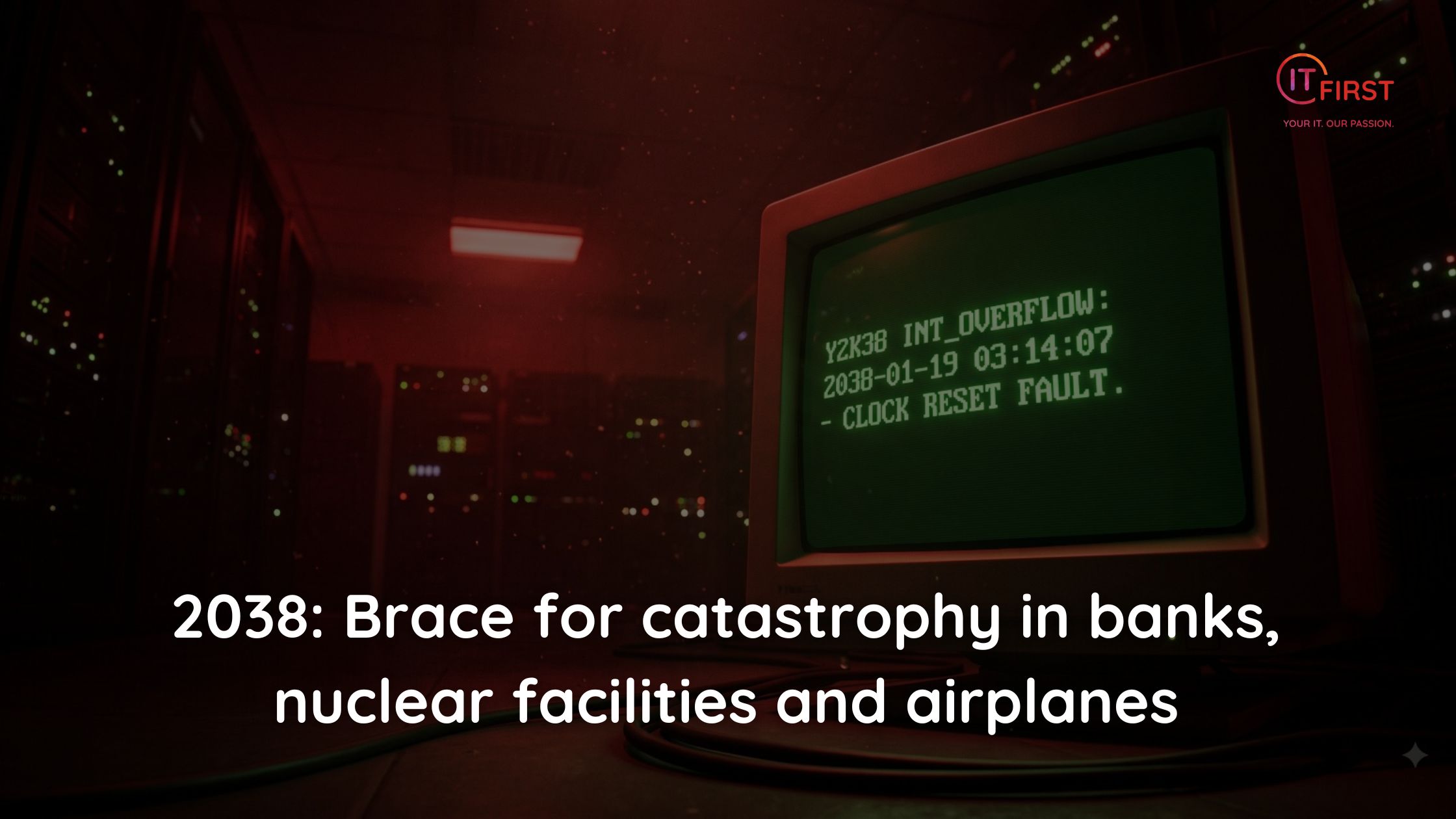
Mark your calendars for January 19, 2038, at 03:14:07 UTC.
If you remember the frantic hoarding of bottled water and canned beans leading up to the year 2000, you might want to brace yourself. There is a very real, scientifically proven ticking clock embedded deep within the digital infrastructure of our modern world. It’s called the Y2K38 problem (or the “Epochalypse”), and rumor has it that it could trigger a technological dark age, causing commercial airliners to drop from the sky and nuclear reactors to spiral into catastrophic meltdowns.
But before you start building an off-grid bunker, let’s look at the actual science behind the bug, why these terrifying scenarios are making the rounds, and what reality will actually look like when the clock strikes zero.
What Exactly is the “Epochalypse”?
To understand the panic, you have to understand how computers tell time.
Many computer systems, particularly those built on older Unix-like operating systems, don’t comprehend dates like “January 19, 2038.” Instead, they measure time in seconds starting from a specific moment known as the Unix Epoch: January 1, 1970.
The fatal flaw lies in how that number is stored. Historically, this running tally of seconds has been stored as a 32-bit signed integer. Because of the physical limits of 32-bit architecture, the maximum number it can count up to is 2,147,483,647.
When the clock ticks one second past that maximum limit on January 19, 2038, the computer’s counter will “overflow.” Unable to go any higher, it will flip to its maximum negative value. In the blink of an eye, these computers will believe the year is suddenly 1901.
The Nightmare Scenario: Planes and Power Plants
The reason this sounds so terrifying is because 32-bit architecture isn’t just used in old desktop computers; it is the backbone of embedded systems. These are the tiny, hidden, single-purpose computers that run the physical world.
If critical infrastructure suddenly thinks it’s 1901, the theoretical outcomes sound like a Hollywood disaster script:
-
Aviation: Modern aircraft rely heavily on embedded systems for GPS navigation, inertial guidance, and automated flight controls. If navigation systems experience a sudden integer overflow, the fear is that autopilot computers could crash, routing systems could fail, and planes could become completely disoriented mid-flight.
-
Nuclear Power: Nuclear plants utilize Operational Technology (OT) and Industrial Control Systems (ICS) to manage coolant flow, monitor radiation levels, and trigger automatic safety shutdowns. If a time-stamping error corrupts the data, safety protocols might fail to trigger, or the plant could lose control over its automated cooling sequences.
The Reality Check: Why You Shouldn’t Panic Yet
While the Y2K38 bug is a massive vulnerability that requires billions of dollars of IT labor to fix, the “falling planes and glowing skies” narrative is pure sensationalism. Here is why the world won’t end in 2038:
1. Fail-Safes and Redundancy
Most industries operate under the strictest safety regulations on Earth. A plane’s critical flight control systems, for example, do not rely on absolute “Unix time” to keep the wings level; they operate on real-time relative sensors (like gyroscopes and pitot tubes). If a GPS computer glitches, pilots have redundant analog and independent digital backups. Similarly, nuclear reactors are built with physical, mechanical fail-safes (like gravity-driven control rods) that will shut a reactor down safely even if every computer in the facility were to instantly vaporize.
2. We Are Already Upgrading to 64-Bit
The tech world has known about this problem for decades. The solution is conceptually simple: upgrade systems to 64-bit integers. A 64-bit time counter won’t overflow for another 292 billion years (which is about 21 times the current age of the universe). The vast majority of modern operating systems, from Windows to Linux to Mac, have already made this jump.
3. Time is on Our Side
Unlike the original Y2K bug, where the panic really only set in during the late 90s, we still have more than a decade to swap out legacy hardware. The most at-risk devices aren’t the ones flying planes, they are unpatchable smart TVs, old factory floor sensors, and forgotten Wi-Fi routers (if we can find them all in time)
The Bottom Line
Will Y2K38 cause problems? Absolutely. We will likely see banking errors, expired security certificates, database crashes, and strange glitches in older internet-of-things (IoT) devices. It is going to be an incredibly stressful day for cybersecurity professionals and system administrators.
But your flight will land safely, and the power grid will stay online. The Epochalypse is a massive IT headache, not the end of the world.