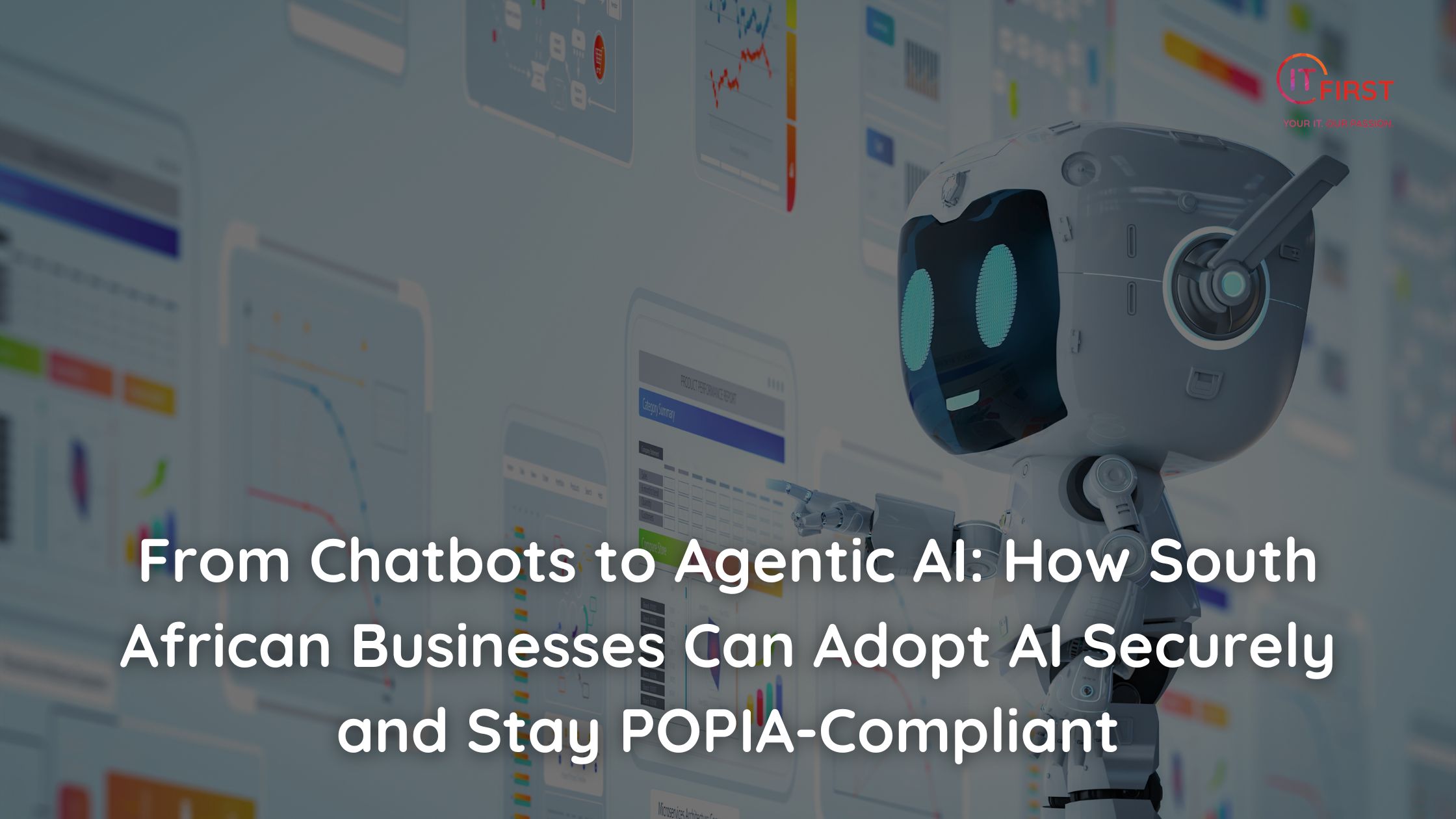
Artificial intelligence has come a long way in a remarkably short time. Just a few years ago, businesses were experimenting with AI-powered chatbots that could answer frequently asked questions or help draft emails. Today, the conversation has shifted towards something far more powerful: Agentic AI.
Unlike traditional AI tools that respond to individual prompts, Agentic AI can complete entire workflows autonomously. These AI agents can analyse information, make decisions, interact with multiple business systems, and perform complex tasks with minimal human intervention.
For businesses, the potential is enormous. Imagine an AI agent that receives a customer complaint, verifies the customer’s account, creates a support ticket, checks stock availability, schedules a technician, and sends follow-up emails, all without requiring manual input.
However, this new level of autonomy also raises important questions about privacy, governance, security, and compliance. In South Africa, where organisations must comply with the Protection of Personal Information Act (POPIA), businesses need to ensure that AI agents operate responsibly and transparently.
The challenge is no longer simply how to use AI, it’s how to use it safely.
What Is Agentic AI?
Traditional AI systems are reactive. They perform one task at a time based on a user’s prompt.
For example, you might ask an AI assistant to:
- Write an email
- Summarise a report
- Translate text
- Generate a marketing caption
Once the task is complete, the interaction ends.
Agentic AI works differently.
Instead of responding to a single request, an AI agent can:
- Plan multiple steps
- Gather information from different sources
- Make decisions based on predefined rules
- Interact with business software
- Complete tasks automatically
- Monitor progress and adjust its actions
In other words, Agentic AI acts more like a digital employee than a digital assistant.
Why Businesses Are Interested in Agentic AI
The appeal is easy to understand.
Businesses are constantly looking for ways to reduce repetitive work and improve efficiency.
An AI agent could potentially:
- Process customer service requests
- Generate reports automatically
- Schedule appointments
- Monitor inventory
- Route support tickets
- Assist HR with onboarding
- Analyse sales performance
- Coordinate internal workflows
Instead of employees manually switching between multiple systems, an AI agent can perform these tasks automatically.
This saves time, reduces operational costs, and allows employees to focus on higher-value work.
The POPIA Challenge
While Agentic AI offers exciting possibilities, it also introduces new privacy and compliance risks.
Unlike a basic chatbot, an AI agent may need access to:
- Customer records
- Employee information
- Financial systems
- Internal documents
- Emails
- CRM platforms
- Cloud storage
Because these systems often contain personal information, businesses must ensure that AI agents comply with POPIA at every stage.
Simply giving an AI unrestricted access to company data is not only risky, it may also create significant legal and compliance concerns.
Why AI Governance Matters
One of the biggest concerns surrounding Agentic AI is governance.
Governance refers to the policies, controls, and oversight that determine how AI systems operate.
Businesses should be able to answer questions such as:
- What information can the AI access?
- Why did the AI make a particular decision?
- Who approved the AI’s actions?
- Can those decisions be reviewed later?
- How is sensitive information protected?
Without proper governance, businesses risk losing visibility into how AI is making decisions.
For highly regulated industries such as healthcare, finance, and legal services, this level of oversight is essential.
Building an Explainability Layer
One of the biggest criticisms of modern AI is that it often behaves like a “black box.”
An AI may produce an answer or make a recommendation without clearly explaining how it reached that conclusion.
This creates challenges for businesses that need accountability.
An explainability layer helps solve this problem by recording:
- The original request
- The information the AI accessed
- Which systems it interacted with
- The reasoning behind its actions
- The final decision or outcome
If an issue arises later, businesses can review exactly what happened.
This level of transparency is becoming increasingly important for compliance, audits, and customer trust.
Logging Every Decision
As AI becomes more autonomous, businesses should consider maintaining detailed audit logs.
These records may include:
- Prompts submitted to the AI
- Data sources used
- Systems accessed
- Decisions made
- Actions performed
- Human approvals where applicable
- Time stamps
Comprehensive logging helps organisations:
- Demonstrate compliance
- Investigate incidents
- Improve AI performance
- Detect misuse
- Strengthen accountability
If a customer questions an AI-generated decision, businesses should be able to explain how that decision was reached.
Should AI Agents Make Decisions on Their Own?
The short answer is: not always.
Not every business process should be fully automated.
For low-risk tasks such as:
- Scheduling meetings
- Categorising support requests
- Drafting emails
- Updating routine records
AI autonomy may be perfectly acceptable.
However, decisions involving:
- Financial approvals
- Customer disputes
- Legal matters
- Hiring decisions
- Sensitive personal information
should generally include human oversight.
Many organisations are adopting a “human-in-the-loop” approach, where AI completes the groundwork, but a person reviews and approves critical decisions before they are finalised.
This balances efficiency with accountability.
Reducing Cloud Costs Without Sacrificing Performance
Another concern for South African businesses is cost.
Running advanced AI models entirely through cloud APIs can become expensive, particularly when agents perform thousands of actions every day.
Businesses are exploring several ways to reduce these costs:
Use Smaller AI Models Where Appropriate
Not every task requires the largest or most advanced model.
Simple administrative tasks can often be handled effectively by smaller, more affordable models.
Use AI Selectively
Instead of using AI for every interaction, businesses can reserve it for tasks where it delivers the greatest value.
Routine automation may still be handled by traditional software.
Cache Frequently Used Information
Rather than repeatedly querying an AI model for the same information, businesses can store commonly used responses and reuse them when appropriate.
This reduces API usage and improves response times.
Consider Hybrid AI Deployments
Some organisations are combining cloud-based AI with locally hosted models.
This approach can:
- Reduce ongoing cloud costs
- Improve response times
- Keep sensitive information within the organisation’s environment
- Provide greater control over business data
For businesses handling highly sensitive customer information, hybrid deployments can also support stronger privacy practices.
Teaching AI South African Context
One of the biggest challenges with global AI models is that they are not always familiar with local business environments.
South African businesses often need AI systems to understand:
- Local legislation such as POPIA
- South African English
- Local terminology and spelling
- Industry-specific regulations
- Internal company policies
- Regional customer expectations
Rather than training a completely new AI model, which can be prohibitively expensive, many organisations customise existing models by providing secure access to internal knowledge bases, documentation, and company policies.
This allows AI to generate responses that are more accurate and relevant without the cost of building a model from scratch.
Best Practices for Implementing Agentic AI
Businesses planning to adopt Agentic AI should consider the following:
- Define clear governance policies before deployment.
- Limit AI access using the principle of least privilege.
- Keep detailed audit logs of prompts, decisions, and actions.
- Protect sensitive information through encryption and access controls.
- Require human approval for high-risk decisions.
- Regularly review AI performance and accuracy.
- Train employees on responsible AI use.
- Ensure AI processes align with POPIA and other regulatory requirements.
Successful AI adoption is not just about choosing the right technology, it’s about implementing it responsibly.
Final Thoughts
Agentic AI represents the next major evolution in business automation. Unlike traditional chatbots, these intelligent agents can manage workflows, interact with multiple systems, and make decisions that significantly improve productivity and operational efficiency.
However, greater capability comes with greater responsibility.
For South African organisations, success will depend on balancing innovation with governance, transparency, and compliance. Businesses that invest in explainability, secure data handling, human oversight, and POPIA-aligned policies will be far better positioned to unlock the benefits of Agentic AI while maintaining customer trust.
The future of AI is not simply about building smarter systems, it’s about building systems that are secure, accountable, and designed to operate responsibly in the real world.