For years, phishing emails were relatively easy to spot. They often contained poor grammar, suspicious links, awkward wording, and obvious spelling mistakes. Businesses taught employees to look for these warning signs, and while phishing remained a serious threat, many attacks could be identified with a careful eye.
In 2026, however, the landscape has changed dramatically.
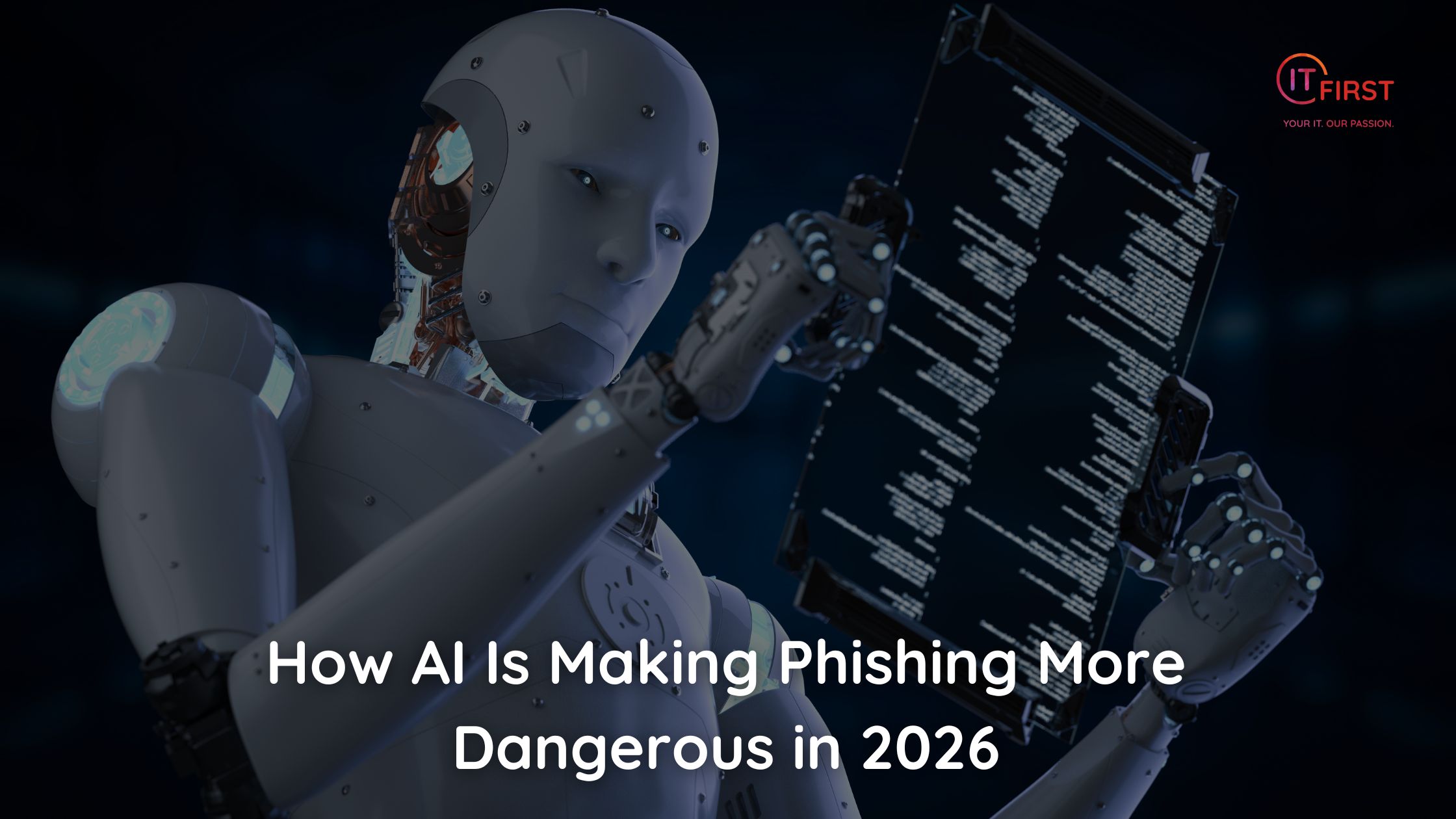
Artificial intelligence has given cybercriminals access to tools that can generate convincing emails, realistic fake websites, cloned voices, and even video deepfakes in a matter of minutes. What once required technical expertise can now be done quickly, cheaply, and at scale.
As AI continues to evolve, phishing attacks are becoming more sophisticated, more personalised, and significantly harder to detect. For businesses, this means traditional awareness alone is no longer enough, organisations need to adapt to a new generation of cyber threats.
Phishing Has Evolved Beyond Poorly Written Emails
Traditional phishing attacks relied on sending the same generic email to thousands of people in the hope that someone would click on a malicious link.
AI has changed that approach completely.
Instead of sending poorly written messages, attackers can now generate emails that:
- Match a company’s writing style
- Use flawless grammar and spelling
- Include accurate business terminology
- Reference recent events or projects
- Personalise messages for individual employees
Because these emails appear more authentic, employees are far more likely to trust them.
An email that appears to come from your manager, supplier, or bank is no longer easy to dismiss based on spelling mistakes alone.
AI Makes Spear Phishing Easier Than Ever
One of the biggest changes AI has introduced is the rise of highly targeted phishing, often referred to as spear phishing.
Rather than sending thousands of generic emails, cybercriminals can use publicly available information from:
- Company websites
- Press releases
- Social media profiles
- Business directories
AI can analyse this information in seconds and generate personalised phishing messages that reference:
- An employee’s role
- Recent company announcements
- Clients or suppliers
- Current projects
- Industry terminology
The result is a phishing email that feels genuine because it contains accurate and relevant information.
The more personalised the message, the greater the likelihood that someone will respond.
Voice Cloning Is Creating New Risks
AI is no longer limited to text.
Modern voice-cloning technology can recreate a person’s voice using only a short audio sample, some models requiring just a few seconds of recorded speech.
This creates new opportunities for cybercriminals.
Imagine receiving a phone call that sounds exactly like your CEO asking you to urgently transfer funds or share confidential information.
Without additional verification, many employees may comply simply because they recognise the familiar voice.
This type of attack, sometimes called vishing (voice phishing), is becoming increasingly realistic as AI models continue to improve.
Deepfake Videos Are Becoming More Convincing
Video deepfakes are another growing concern.
AI can now generate realistic videos that appear to show executives, business partners, or public figures speaking directly to employees.
While many deepfakes still contain subtle imperfections, the technology is improving rapidly.
Businesses could eventually face scenarios where employees receive convincing video messages requesting:
- Urgent payments
- Password resets
- Sensitive documents
- Changes to banking details
- Confidential project information
As trust shifts from written communication to video, deepfakes introduce an entirely new level of social engineering.
AI Can Launch Larger Phishing Campaigns Faster
Before AI, creating convincing phishing campaigns required time and effort.
Today, attackers can automate much of the process.
AI can help cybercriminals:
- Write thousands of unique phishing emails
- Translate messages into multiple languages
- Personalise attacks automatically
- Generate convincing fake websites
- Create realistic chatbot conversations
- Respond to victims in real time
This means attackers can scale their operations without significantly increasing costs.
Businesses are no longer facing isolated attacks—they are facing highly automated phishing campaigns capable of targeting thousands of organisations simultaneously.
Business Email Compromise Is Becoming More Sophisticated
Business Email Compromise (BEC) remains one of the most financially damaging forms of cybercrime.
In these attacks, criminals impersonate senior executives, suppliers, or trusted partners to trick employees into making payments or sharing confidential information.
AI has made these attacks even more convincing by enabling criminals to:
- Replicate writing styles
- Mimic business communication patterns
- Generate believable invoices
- Create realistic email conversations
- Respond naturally to follow-up questions
Employees may believe they are communicating with a trusted colleague when they are actually interacting with an AI-assisted cybercriminal.
How Businesses Can Protect Themselves
Although AI is making phishing attacks more dangerous, businesses can still reduce their risk by adopting stronger security practices.
Invest in Regular Employee Training
Training should now include:
- AI-generated phishing examples
- Voice-cloning awareness
- Deepfake recognition
- Verification procedures
- Safe handling of unexpected requests
Employees should understand that professional-looking messages are no longer automatically trustworthy.
Enable Multi-Factor Authentication (MFA)
Even if login credentials are stolen through phishing, Multi-Factor Authentication provides an additional layer of protection that can prevent attackers from accessing business accounts.
MFA should be enabled wherever possible, particularly for:
- Email platforms
- Cloud storage
- Financial systems
- Customer databases
- Administrative accounts
Verify Unusual Requests
Businesses should establish clear procedures for verifying requests involving:
- Financial transactions
- Banking detail changes
- Password resets
- Confidential information
- Sensitive documents
A quick phone call using a known contact number—or speaking to the person face-to-face—can prevent a costly mistake.
Employees should never rely solely on email, voice messages, or video calls for high-risk requests.
Use Advanced Email Security
Modern email security platforms increasingly use AI themselves to detect:
- Phishing attempts
- Malicious attachments
- Suspicious links
- Spoofed email addresses
- Unusual communication patterns
Combining AI-powered defence with human awareness provides much stronger protection than either approach alone.
Develop an Incident Response Plan
Even with strong preventative measures, phishing attacks may still succeed.
Businesses should have a documented process for:
- Reporting suspicious emails
- Isolating compromised accounts
- Resetting credentials
- Investigating incidents
- Communicating with affected customers
- Meeting legal or regulatory obligations
Responding quickly can significantly reduce the impact of an attack.
The Future of Phishing
As artificial intelligence continues to improve, phishing attacks are likely to become even more convincing.
Future attacks may include:
- Real-time AI conversations with victims
- Fully interactive fake customer support agents
- Hyper-personalised scams based on public data
- More realistic voice and video impersonation
- Automated attacks that adapt based on a victim’s responses
The challenge for businesses will be keeping pace with technology that is evolving faster than traditional security awareness programmes.
Final Thoughts
Artificial intelligence is transforming both cybersecurity and cybercrime. While businesses are using AI to improve productivity and strengthen security, cybercriminals are using the same technology to create phishing attacks that are more convincing than ever before.
The days of spotting phishing emails simply by looking for poor grammar or spelling mistakes are rapidly disappearing. In 2026, the strongest defence is a combination of employee awareness, robust security controls, verification procedures, and a culture that encourages staff to question unexpected requests.
Businesses that recognise how AI is changing the threat landscape will be far better prepared to defend themselves against the next generation of phishing attacks.